
The short answer
37 sources below
In 2027 your buyers ask an AI assistant before they search, and the assistants answer from "best of" lists, comparisons and Reddit threads far more than from your own site. Agents have started to use software on people's behalf, and more than three in four leading cloud companies already run a server for them. Start publishing what assistants quote, make your product usable by agents, and ask every signup where they heard of you. Change how you run SEO, cold email, social and launches, and stop the automated volume that platforms now punish.
On this page13 sections
Key findings#
We ran two studies for this guide in November 2026 and read search demand for the practices in it in Next Big. Methods are at the end.
- We asked four AI engines for "the best [category] tools for a small team" in 50 SaaS categories. Of the 1,660 sources they cited, 54% were articles, mostly "best of" lists, comparisons and "alternatives" pages.
- Google's AI Mode cited Reddit in 42 of 50 answers and YouTube in 35. ChatGPT, Claude and Gemini cited Reddit in none.
- G2 or Capterra appeared in 2 of 50 AI Mode answers, 6 of 50 ChatGPT answers and 8 of 50 Gemini answers.
- For the same question, AI Mode and ChatGPT shared on average 13% of the domains they cited. In 12 of the 50 categories they shared none.
- 60% of ChatGPT's links went to the products it recommended. Claude linked a vendor's own page in 6% of its citations.
- 125 of 163 leading cloud companies (77%) run an official MCP server that works on a customer's own account. 28 of those 125 are listed in the official MCP registry.
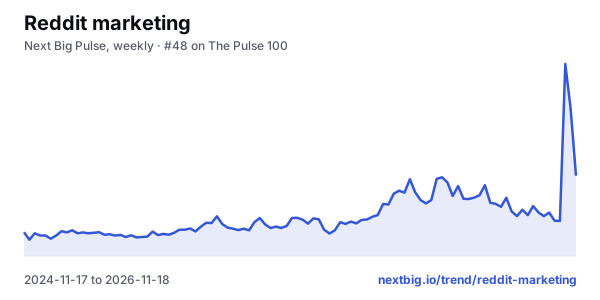
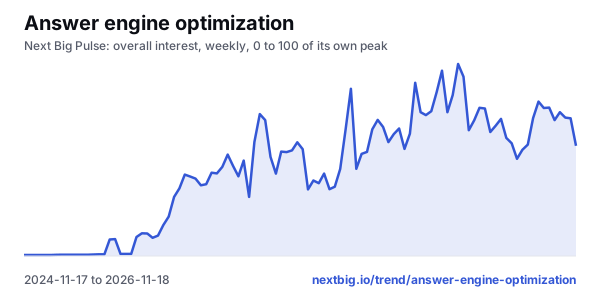
- Searches for "generative engine optimization" doubled in a year. "Answer engine optimization" rose 81% and "reddit marketing" 158%.
- Interest in faceless YouTube channels, the side hustle of 2025, fell 40% in a year.
The 2027 scorecard#
| Move | Impact | Effort | First result | Suits |
|---|---|---|---|---|
| Start: get quoted in AI answers | High | Medium | 1 to 3 months | Everyone |
| Start: make the product usable by agents | High | Medium | 1 to 2 months | B2B, dev tools |
| Start: publish original data | High | High | 2 to 3 months | B2B |
| Start: creator and AI UGC ads | High | Medium | 2 to 4 weeks | Consumer apps |
| Start: ask every signup where they heard of you | Medium | Low | 1 week | Everyone |
| Change: fewer SEO pages, written to be quoted | High | Medium | 2 to 4 months | Everyone |
| Change: cold email in batches of fifty | Medium | Low | 2 weeks | B2B |
| Change: reply under bigger accounts | Medium | Low | 2 to 4 weeks | Everyone |
| Change: launch for a week | Medium | Medium | 1 launch | Everyone |
| Change: newsletter as the main owned channel | Medium | Low | 2 to 3 months | Everyone |
| Change: no form in front of the product | High | Medium | 2 to 4 weeks | Everyone |
| Change: community answers in public | Medium | High | 3 to 6 months | Everyone |
| Stop: AI-written posts at scale | ||||
| Stop: volume cold email and AI-SDR sequences | ||||
| Stop: engagement hacks | ||||
| Stop: faceless content farms | ||||
| Stop: bought followers or views | ||||
| Stop: lifetime deals as a launch | ||||
| Stop: vanity metrics |
The ratings are our judgement, for a team of one to five people.
What changed in 2026#
Four shifts drive almost every item on the scorecard.
Buyers ask an assistant before they search#
G2 surveyed 1,076 B2B software buyers in March 2026: 51% now start their research in an AI chatbot more often than in Google, up from 29% a year earlier.
Google's own AI Mode drew about 2.2 million searches a month for its name in 2026, five times the interest of a year before. The assistants are also splitting the market: searches for ChatGPT fell 17% in a year while searches for Claude rose 165% and Gemini 33%.
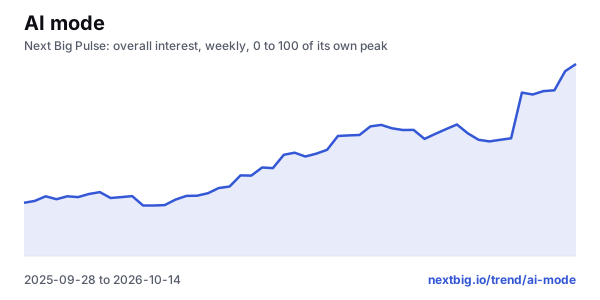
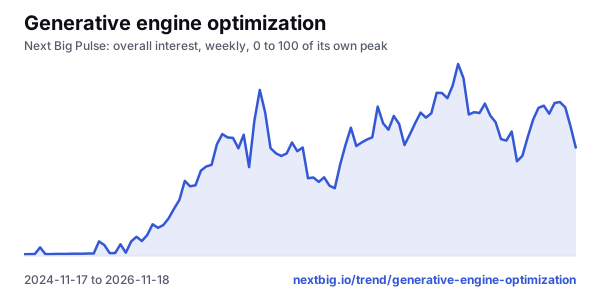
Our study shows what those assistants read: third-party lists and comparisons for most of them, Reddit and YouTube for Google. This drives Start 1 and 3 and Change 1.
Agents use software for people#
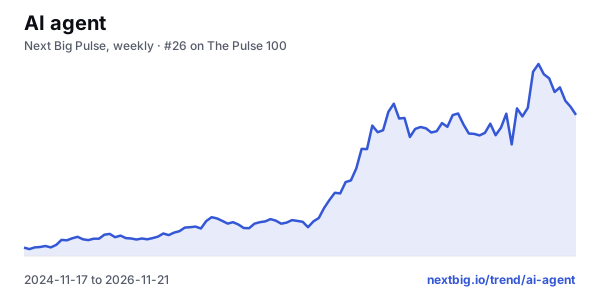
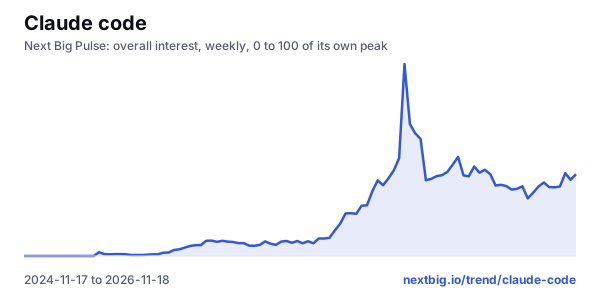
"Claude Code" reached about 550,000 searches a month in 2026, more than four times the year before, and searches for "AI agents" grew 143%.
The Model Context Protocol became the standard way to hand an agent a tool: Anthropic gave it to the Linux Foundation's new Agentic AI Foundation, an official registry lists public servers, and Claude and ChatGPT both run reviewed directories of them. Our census found product servers at 77% of leading cloud companies. This drives Start 2.
Automated volume hit the platforms' limits#
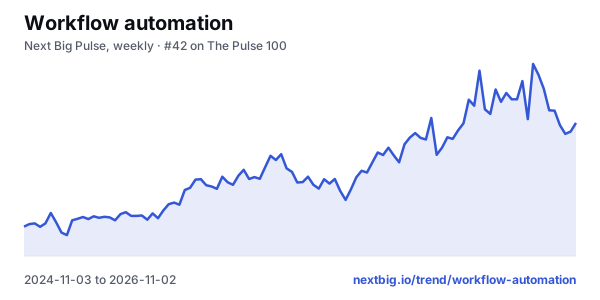
Searches for "workflow automation" rose 74% in a year, and advertisers pay about $60 a click for the term.
The platforms answered with rules. Gmail asks senders to stay under a 0.1% spam rate and never reach 0.3%. X bans automated replies triggered by keyword searches and needs its written approval for any AI reply bot. LinkedIn said in March 2026 that it is working to make engagement pods ineffective. Google's spam policies name scaled content abuse: pages made in bulk to rank, however they were written. This drives Change 2 and 3 and Stop 1 to 3.
Reach moved to owned channels and real people#
X filters strangers' replies out of For You and LinkedIn is cutting engagement bait, so the audiences you own gained value.
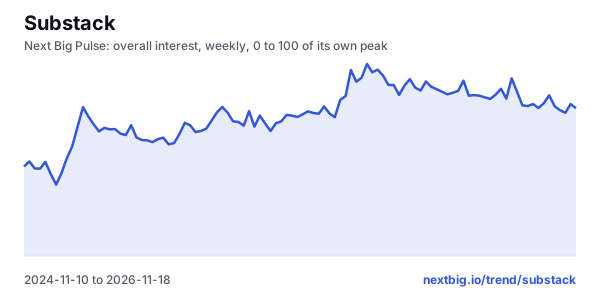
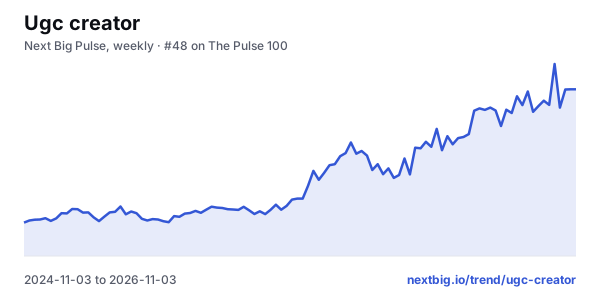
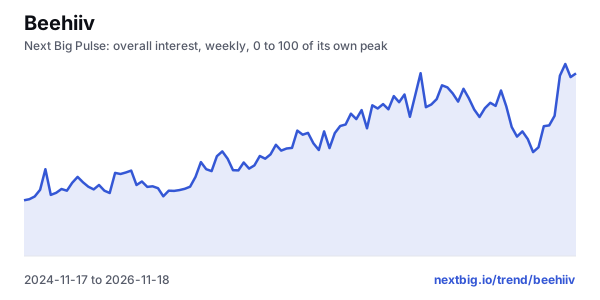
Interest in Substack is six times its 2021 level and beehiiv doubled in two years. Searches for "UGC creator" are almost three times their 2023 level, and "UGC ads" rose about thirtyfold in two years. Faceless content went the other way. This drives Start 4, Change 5 and Stop 4.
Start in 2027#
Five practices that were rare in 2025 and pay off in 2027.
Get quoted in AI answers#
Assistants build their answer from the pages they retrieve, and for software those pages are mostly lists written by someone else. In our study, 78% of Gemini's sources and 86% of Claude's were articles, most of them "best of" lists and comparisons. Being on those lists, and publishing your own honest ones, matters more than polishing your homepage.
Which engine your buyers use changes the work. Google's AI Mode cited Reddit in 42 of 50 answers and YouTube in 35; no other engine cited Reddit once. ChatGPT links straight to the products it names, so being named is what counts there. The engines also disagree: AI Mode and ChatGPT shared 13% of their sources on average, so a page that wins on one can be absent from the other.
Google says AI Overviews and AI Mode need no special files or markup; the fundamentals of SEO apply. Structure still matters for the others. AirOps studied 12,000 URLs cited by ChatGPT: 87% had a single H1, against 64% of Google's page-one results, and 69% used headings in order, against 24%.
- Ask ChatGPT, Claude, Gemini, Perplexity and Google AI Mode the ten prompts below about your category, and save every answer and every source word for word.
- Check your server logs for OAI-SearchBot, Claude-SearchBot and PerplexityBot. Since July 2025 Cloudflare asks every new domain whether to allow AI crawlers and blocks them by default, so a site can be invisible without anyone choosing it.
- Publish an honest "best [category] tools" page with your competitors on it, and an alternatives page for each of your four biggest competitors.
- Get onto the lists the engines already cite for your category. Your baseline names them; email each author with one fact their page is missing.
- If your buyers use Google, answer the Reddit threads AI Mode cites for your category, and say who you are in the first line.
- Rewrite your ten most important pages answer-first: one H1, the answer in the first two sentences, headings in order and a table wherever buyers compare.
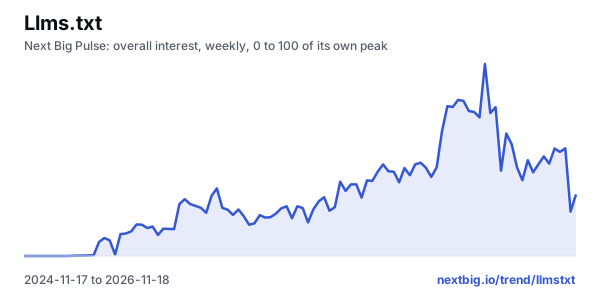
- Publish llms.txt and serve a Markdown copy of each page. Claude fetched a Markdown copy of a list page in our study; it costs half an hour.
- Re-run the prompts every month and read GA4's AI Assistant channel and Bing Webmaster Tools' AI Performance report.
The ten baseline prompts:
- What are the best [category] tools for a small team?
- What are the best alternatives to [market leader]?
- How do I choose a [category] tool?
- [Your product] vs [main competitor]
- Is [your product] good for [use case]?
- What does [your product] cost?
- Best [category] tool for [industry]
- Best free [category] tool
- Best [category] tool that integrates with [tool your buyers use]
- What do people on Reddit recommend for [category]?
For consumer apps. People ask "what's the best app for [problem]". Name the problem in the first lines of your store listing, answer the threads where people ask, and get one honest review video made for each of your three main use cases.
Skip this if your buyers find you only through sales and referrals, and you can name every account you will sell to this year.
How you know it works: you appear in three of your ten baseline answers within a quarter, and AI Assistant visits convert better than organic search.
Tools: Bing Webmaster Tools, Search Console, GA4 and Microsoft Clarity are free. Profound, Peec AI and Otterly track citations across engines for a fee.
Make your product usable by agents#
An agent can't watch your demo. It reads your docs, calls your API and uses the tools it is given, so the products it can operate are the ones it picks.
We checked 163 leading cloud companies, the 2025 Forbes Cloud 100 and the public BVP cloud index. 125 of them (77%) run an official MCP server that works on a customer's own account: Stripe, Notion, HubSpot, Salesforce, Atlassian, Figma and Shopify among them. Six more, including OpenAI and Anthropic, run a server that only searches their documentation. Only 28 of the 125 are listed in the official MCP registry, so most of the market is missing from the one directory every agent can query.
- Build a remote MCP server for the five to ten things customers do most in your product. Start with reading and creating, and put anything destructive behind the user's approval.
- Publish it to the official MCP registry: a server.json sent with mcp-publisher, your domain proved by a DNS record, an HTTP file or a GitHub login, and a description of 100 characters or fewer. Published versions can't be edited.
- Submit it to the Claude directory and the ChatGPT Directory. Both take only remote servers over HTTPS. Claude scans each submission and lists it as a community connector; it needs OAuth 2.0 for anything that acts on an account, a read-only or destructive hint on every tool and a privacy policy, and a verified listing adds a human review.
- List it on Smithery and Glama, where developers browse.
- Make the docs readable by agents: llms.txt pointing at them, Markdown pages, an OpenAPI file and a quickstart that can be pasted.
- Write one "use [product] with Claude, ChatGPT or Cursor" page for each assistant.
For consumer apps. If your app does a job people already ask an assistant for, such as planning meals or tracking spending, build that one job as an app inside ChatGPT or a connector in Claude. Shopify's agent servers show the shape: search a catalogue, fill a cart, check out.
Skip this if nothing in your product is worth doing without opening it.
How you know it works: weekly connections from the directories, and signups whose first action came through the API or the server.
Tools: the MCP Inspector, the official registry, Smithery and Glama are free.
Publish original data#
A number with a date, a sample and a source is something an assistant or a reporter can lift whole and credit to you.
- Pick a question your buyers ask that has no public answer. "How long does onboarding take in [category]?" beats "the state of [category]".
- Collect the data: your own product data, anonymised and aggregated; public data nobody has counted; or a survey of a hundred customers.
- Publish it on its own page with a date, the sample, a short method and the data as a CSV people may reuse.
- Write each finding as one sentence that makes sense quoted alone.
- Offer it to one newsletter first, then to ten writers who cover your buyers.
- Re-run it every quarter, so it becomes a series that is quoted again.
This guide is the example: the citation study and the MCP census below are original data.
Skip this if you cannot keep the numbers current. A stale study is quoted against you.
How you know it works: referring domains to the study page, and the study turning up in your baseline answers.
Creator ads and AI UGC for consumer apps, founder clips for B2B#
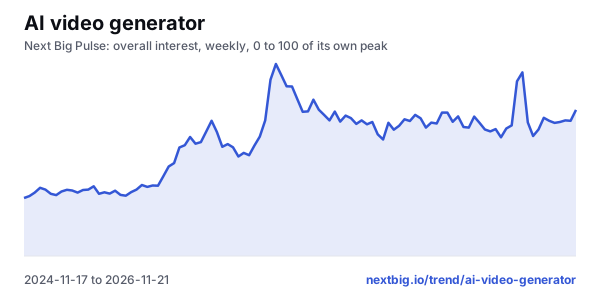
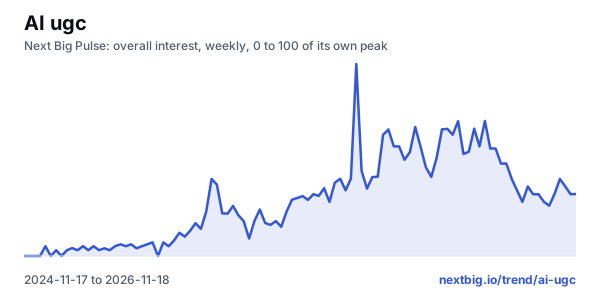
Ads made by creators and customers grew fast, and AI tools now make a passable version in minutes. Searches for "AI UGC" did not exist before 2025.
Do it, consumer apps:
- Run one account about the problem your app solves, with the app as the answer, and say in the bio that it's yours.
- Post a photo slideshow daily: the pain on slide one, the app on slide two. Change one thing per post so a winner tells you why it won.
- Pay creators a flat monthly fee. Cal AI's founder said in 2025 that it paid about 250 creators this way; MyFitnessPal bought the company that December.
- Test AI UGC ads against creator ads with the same hook, and keep whichever wins on cost per trial. Label AI-generated people where the platform requires it.
- Disclose. The FTC's 2024 rule covers insider testimonials that hide the connection, and TikTok requires its commercial-content label on any post that promotes a product.
Do it, B2B:
- Record the product's best half minute as a raw, captioned screen clip with no intro.
- Ask one customer for a two-minute call recording with real numbers in it.
- Publish the YouTube video that answers each of ten "best X for Y" queries your buyers type there. Google's AI Mode cited YouTube in 35 of our 50 answers.
Skip this if you sell six-figure contracts to IT departments.
How you know it works: cost per trial on ads, three-second hold rate on clips.
Ask every signup where they heard of you#
Assistants answer without sending a click, and GA4 files AI Overviews and AI Mode visits under organic search, so your analytics undercounts what assistants send you. One question at signup fills the gap.
- Add one field to signup: "How did you hear about us?" Make it free text, with an optional list.
- Read the answers every week and tag them.
- Compare the tags with GA4's channels each month. The difference is your dark traffic.
The options list: ChatGPT or another AI assistant · Google search · Reddit · YouTube · LinkedIn · X or Threads · a newsletter (which?) · a podcast (which?) · a friend or colleague · other.
How you know it works: at least half of new signups answer, and you can name your top three sources by revenue.
Change in 2027#
Seven channels to keep, run differently.
SEO: fewer pages, written to be quoted#
In 2025: a post per keyword, as many as the team could write. In 2027: fewer pages, each answering one question completely, plus the comparison and alternatives pages assistants quote.
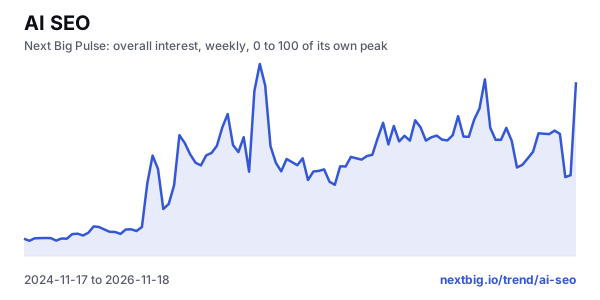
Google treats pages made in bulk to rank as scaled content abuse, whoever or whatever wrote them. Searches for "AI SEO" rose 43% in a year and more than eightfold in two.
- Merge pages that answer the same question; keep the one that earns clicks.
- Rewrite the survivors answer-first, with one H1 and headings in order.
- Add a comparison table to every page where buyers choose between options.
- Publish alternatives pages for your top four competitors, with an honest table.
- Read Search Console's report on AI Overviews and AI Mode to see which pages Google draws on.
Cold email: fifty at a time, one reason, a person on send#
In 2025: sequences to thousands, written and sent by software. In 2027: batches of fifty or fewer, one trigger each, a person approving every send.
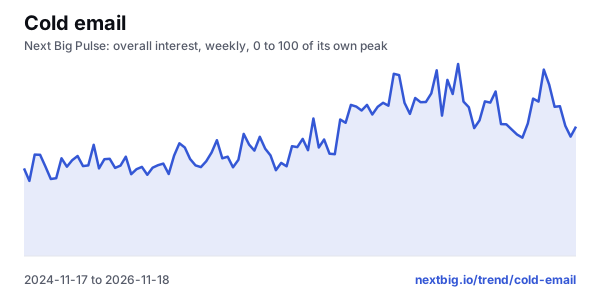
Hunter analysed 11 million cold emails sent in 2024: campaigns to fifty people or fewer averaged 5.8% replies, against 2.1% for campaigns over a thousand. Belkins and Expandi studied LinkedIn outreach across 15 million contacts: campaigns written with an AI prompt got 7.3% replies, against 7.0% without. Searches for "cold email" still rose 34% in a year.
- Send from a second domain with SPF, DKIM and DMARC, warmed up for weeks.
- Build each batch around one trigger true of everyone in it: a hiring post, a new person in the role that buys, a funding round (most US raises under Reg D appear as a Form D filing within 15 days) or a public complaint about a competitor.
- Open with one finding about their business, with a screenshot.
- End by asking whether they're interested. Gong analysed 304,174 emails, and that ask booked more meetings than any other.
- Add a one-click unsubscribe even at low volume, and keep your spam rate under 0.1%.
- Let AI research and draft; approve every send yourself.
The difference, in one email:
- 2025: "Hi {first_name}, I noticed {company} is growing fast! We help teams like yours 10x their pipeline with AI. Do you have 15 minutes on Thursday?"
- 2027: "Hi Dana, your pricing page lists annual billing only, and three of your G2 reviews this quarter ask for monthly. We added monthly plans for two tools in your space last year; one is in the screenshot. Worth a look?"
Social: reply under bigger accounts, write for Threads on its own#
In 2025: post, then hope the feed shows it. In 2027: reply early under accounts your buyers already read, and treat each network as its own channel.
X publishes its For You ranker. In the parameters synced on 13 November 2026:
| Action the ranker predicts | Weight |
|---|---|
| Reply | 5.0 |
| Quote | 5.0 |
| Share by DM | 5.0 |
| Follow the author | 4.0 |
| Like | 0.708 |
| Reply between two accounts that follow each other | +15.0 |
The code drops replies from accounts a viewer doesn't follow out of their For You feed, so strangers read your reply inside the thread under the big post.
- List thirty accounts your buyers read that are bigger than you but small enough to answer.
- Turn on notifications and reply within the hour with a number, a counterexample or a worked step.
- Pin one post that turns a profile visit into a signup.
- Write for Threads separately: Meta reports more than 500 million monthly users, and a topic tag helps a post reach people who don't follow you.
- If your buyers are on Bluesky, build the starter pack for your niche. A study of 335,416 packs found members gained up to 85% more followers.
- On LinkedIn, link the resource in the post rather than asking for comments; LinkedIn said in March 2026 it is cutting engagement bait such as "comment to agree" prompts. On Instagram, an automated comment-to-DM flow is within Meta's rules.
Launches: a week, with Product Hunt as one day of it#
In 2025: one launch day, mostly on Product Hunt. In 2027: five features shipped over five days, with a dated changelog between launches.
In March 2021 Supabase turned a planned launch day into a week and shipped seven features, one a day. It has repeated the format since. Product Hunt now features far fewer launches and hides the rest behind "See all", and its FAQ forbids asking for upvotes.
The launch-week calendar:
| Day | Ship | Channel |
|---|---|---|
| Monday | The biggest feature | Your list, X, LinkedIn |
| Tuesday | The most technical one | Show HN |
| Wednesday | The most visual one | Product Hunt |
| Thursday | The integration | The partner's newsletter |
| Friday | The small one users asked for | Community, changelog |
- Hold back five finished features; a week of thin features makes the product look thin.
- Have each written up by the person who built it, with a short film.
- On Show HN, post only what people can try now, and stay in the thread all day.
- Post every changelog entry between launch weeks.
- For consumer apps, nominate each feature for App Store featuring in App Store Connect a few weeks ahead.
Email: the newsletter becomes your main owned channel#
In 2025: a newsletter when there was news. In 2027: a fixed cadence, a format that writes itself, and a LinkedIn newsletter beside it.
- Pick a cadence you can hold on your worst week. Fortnightly is fine.
- Use a format that writes itself: what you shipped and learned, or one teardown per issue.
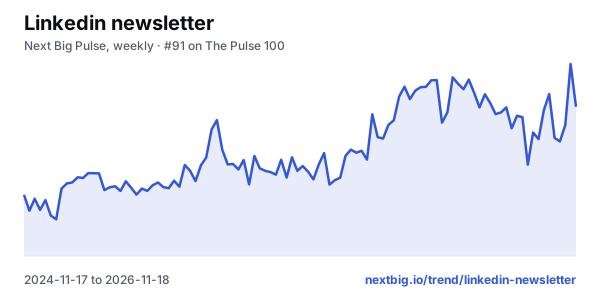
- Start a LinkedIn newsletter with the same issues. LinkedIn notifies subscribers of every edition, which no post gets.
- Swap recommendations with five newsletters of your size whose readers are your buyers.
- Measure replies and clicks. Apple's Mail Privacy Protection makes open rates unreliable.
Conversion: no form in front of the product#
In 2025: "Book a demo" between the visitor and the product. In 2027: the product, or a click-through of it, on the first screen.
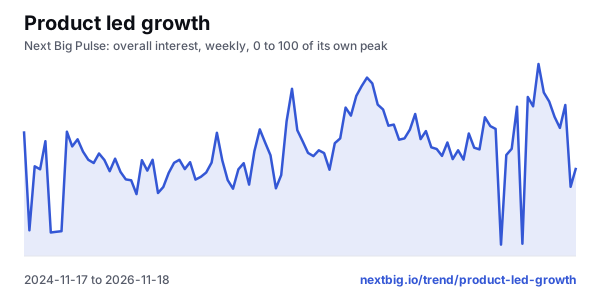
Searches for "product-led growth" nearly doubled in a year. Arcade measured 14 million demo sessions: completion first peaks at 40% for demos of nine to twelve steps, and screenshot demos were finished 41% of the time against 21% for mostly-video ones.
Do it, B2B:
- Put a nine-to-twelve-step click-through demo on the homepage with no form in front of it.
- Ship one free tool that answers a question your buyers search for, and show its answer on the page before asking for an email.
- Judge the demo by the signup rate of visitors who opened it against those who didn't.
Do it, consumer apps:
- Test a hard paywall. RevenueCat's 2026 data shows a median day-35 conversion of 10.7% for hard paywalls against 2.1% for freemium.
- Test a longer trial. Trials of 17 to 32 days converted 42.5% to paid, against 25.5% for trials under four days.
Community: answers in public#
In 2025: a private Discord, judged by member count. In 2027: a room where users answer each other, and the best answers published where search and assistants can read them.
- Open one room: Discord for developers and consumers, Slack for teams at work. Answer every question yourself for ninety days.
- Post a weekly showcase of what users built, with their names on it.
- Give the five people who answer most early access and a direct line to you.
- Turn each month's best answered questions into public pages.
- On Reddit, keep to its own rule of thumb of one post in ten about your work, and ask the moderators before posting anything about your product.
Stop in 2027#
Seven habits that cost more than they return, and what to do instead.
AI-written posts at scale#
Google's spam policies treat pages made in bulk to rank as scaled content abuse, whoever or whatever wrote them. Instead: fewer pages, each complete, and one piece of original data a quarter.
Volume cold email and AI-SDR sequences#
Small campaigns drew almost three times the replies of large ones in Hunter's data, and an AI prompt added three tenths of a point in Belkins'. A spam rate over 0.3% at Gmail puts your domain at risk. Instead: batches of fifty, one trigger, a person on send.
Engagement hacks#
Pods, auto-commenters, AI reply bots and "comment YES to get it". LinkedIn is working to make pods useless and cut comment bait; X bans keyword-triggered automated replies and needs its written approval for AI reply bots. Instead: reply by hand under bigger accounts.
Faceless content farms#
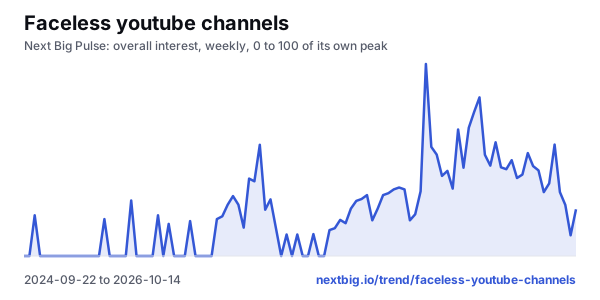
Interest fell 40% in a year after the 2025 rush, and the format is the easiest for AI to copy. Instead: a real person on camera, or an account about a problem that says whose it is.
Bought followers or views#
The FTC's 2024 rule covers knowingly bought bot followers and views, so it is a legal risk as well as wasted money. Instead: a Bluesky starter pack, creator partnerships, replies.
Lifetime deals as a launch#
PPC Land reported in February 2026 that AppSumo's revenue fell by half over two years. Founders who ran a deal describe support they owe forever, and for an AI product every one of those users keeps costing you money. Instead: a launch week, and a dated price rise announced to trial users.
Vanity metrics#
Open rates are inflated by Apple's Mail Privacy Protection, follower counts are cheap to fake, and we found no study tying GitHub stars to signups. Instead: replies, signups by self-reported source, and revenue by channel.
Your first 90 days#
Each cell links back to an item above; do them in this order.
B2B SaaS:
| Weeks | Start | Change | Stop |
|---|---|---|---|
| 1 to 4 | The ten-prompt baseline; the signup question | Second domain and the first batch of fifty | Sequences over fifty; pods |
| 5 to 8 | Best-of and alternatives pages; MCP server | Merge thin pages; ungated demo | Open rate as a target |
| 9 to 12 | First original-data study; registry and directories | Launch week; LinkedIn newsletter | AI-written posts at scale |
Consumer apps:
| Weeks | Start | Change | Stop |
|---|---|---|---|
| 1 to 4 | Problem account with daily slideshows; signup question | Store listing that names the problem | Bought followers |
| 5 to 8 | Creator fees; AI UGC ad test | Hard paywall and trial-length tests | Lifetime deals |
| 9 to 12 | One job as an app in ChatGPT or Claude | Launch week with App Store nominations | Faceless farms |
Hours a week by stage#
For a founder doing marketing alone:
| Work | Before launch | First 100 customers | Past $10k MRR |
|---|---|---|---|
| AI citations and SEO | 3 | 3 | 5 |
| Agents and MCP | 0 | 2 | 2 |
| Original data | 0 | 1 | 3 |
| Video and creators | 1 | 2 | 3 |
| Cold email | 0 | 5 | 3 |
| Replies and social | 3 | 3 | 2 |
| Newsletter | 1 | 2 | 2 |
| Launches and changelog | 2 | 1 | 1 |
| Conversion | 0 | 2 | 3 |
| Community | 0 | 1 | 3 |
| Total | 10 | 22 | 27 |
Put it in a plan with an order and a way to tell when each step is done. That is what marketinque's launch plan is: 466 steps from first visitor to $1M ARR, free and public, each with the reason it's there. If you work with an AI agent, connect it to marketinque's MCP server: it can pick up the next steps and check one off only with evidence, while anything that posts, sends or spends waits for you.
The 2027 tool stack#
| Job | Free | Paid |
|---|---|---|
| AI citations | Bing Webmaster Tools, Search Console, Microsoft Clarity | Profound, Peec AI, Otterly |
| Demand research | Google Trends, Next Big | Exploding Topics, Semrush |
| Agents and MCP | MCP Inspector, the MCP registry | Smithery, Glama |
| Original data | Google Sheets, Datawrapper | Typeform, SurveyMonkey |
| Cold email | Google Postmaster Tools | Hunter, Apollo, Instantly, Lemlist |
| Video | CapCut | Screen Studio, Descript, Arcads, HeyGen, ppl.studio |
| Newsletter | beehiiv, Substack, Kit | Loops, Brevo |
| Demo | Screenshots on your own page | Arcade, Supademo, Navattic |
| Community | Discord, Slack | Circle |
| The plan | marketinque |
The data behind this guide#
AI citation study. On 17 November 2026 we asked "What are the best [category] tools for a small team?" in 50 SaaS categories, from CRM to AI support chatbots. Google AI Mode and ChatGPT (signed out, with search) answered all 50 in a browser; Claude (with web search) answered 20 before the site stopped automated sessions; Gemini 2.5 Flash answered all 50 through its API with Google Search grounding. We recorded every cited link, 1,660 in all, and sorted them by URL into articles, vendor pages, Reddit, YouTube, review sites and other. A hand check of 40 random links found 37 sorted correctly; the three misses were lists filed as vendor pages, so the article share is if anything low. The answers came from a browser in Europe and some were localised. Perplexity was left out because it asked for a human check.
MCP census. We took the 2025 Forbes Cloud 100 (Bessemer replaced the list with an AI 100 in 2026) and the 64 companies in the BVP Nasdaq Emerging Cloud Index, 163 in all. For each we searched the official MCP registry and the company's own documentation, and counted a server only when the company publishes it. A product server works on a customer's own account; a docs-only server searches developer documentation. Five companies stayed unclear.
Download the data. Both datasets are free to reuse with credit (CC BY 4.0): AI citation study, 3,054 cited links, which also holds Gemini's answers to the "alternatives" and "how to choose" prompts, and MCP census, 163 companies, with the evidence link for each. Both are also mirrored, with a citation line, at github.com/zeshutmax/marketinque-data.
Search demand. Trend figures come from Next Big, our search-trend tool, which blends Google web search with other weekly sources. Growth compares the last twelve months with the twelve before; charts show the last two years.
10 questions
Frequently asked questions
What is the biggest SaaS marketing change for 2027?
Buyers asking an AI assistant before they search. Half of B2B software buyers now start in a chatbot more often than in Google, and in our study the assistants built their answers mostly from third-party "best of" lists. If you are not on those lists, you are not on the shortlist.
How do I get my SaaS mentioned by ChatGPT?
Be on the pages it reads. In our study 60% of ChatGPT's links went to products it named and most of the rest to list articles. Publish an honest best-of page, get onto the lists it already cites for your category, and check the same ten prompts every month.
Does Reddit matter for AI search?
For Google, a lot: AI Mode cited Reddit in 42 of our 50 answers. ChatGPT, Claude and Gemini cited it in none. If your buyers use Google, answer the threads AI Mode cites, and say who you are in the first line.
Do G2 and Capterra still matter?
Less for AI answers than most advice says. They appeared in 2 of 50 AI Mode answers, 6 of 50 ChatGPT answers and 8 of 50 Gemini answers. Keep your profiles current; spend the effort on the lists the engines actually cite.
Do I need llms.txt?
It takes half an hour, so publish one, but expect nothing from Google, which says AI Overviews and AI Mode need no special files. It helps the agents and coding tools that look for it.
Should a SaaS build an MCP server?
Yes, if customers do anything in your product an assistant could do for them. 77% of leading cloud companies already run one, and only a fifth of those are in the official registry, so listing yours is still an easy way to stand out.
Are AI UGC ads worth testing?
For a consumer app, yes, as one arm of a test against creator-made ads with the same hook. Label AI-generated people where the platform asks, and keep real customers for testimonials.
How many cold emails can a new domain send a day?
No mailbox provider publishes a daily limit for small senders. Gmail publishes spam-rate thresholds: stay under 0.1% and never reach 0.3%. Start at single digits per inbox per day and keep batches to fifty or fewer.
Is Product Hunt still worth it?
As one day inside a launch week, yes. Since 2024 Product Hunt has featured far fewer launches and hides the rest behind "See all", so it no longer works as a whole launch on its own.
Does X penalise posts with links?
The current ranker parameters contain no link penalty. Opening a link carries a weight of 0.2, against 5.0 for a reply, so a link post earns less from the action it invites. Put the link in the post with context.
Every link opened 17 Nov 2026
Sources
- marketinque: AI citation study and MCP census, November 2026 (this page)
- Next Big: search interest, searches a month and cost per click, read 17 November 2026 (nextbig.io)
- G2: The Answer Economy, March 2026
- Google Search Central: AI features and your website
- Google Search Central: Spam policies, scaled content abuse
- AirOps: Structuring content for LLMs, 2025
- Cloudflare: Content Independence Day and press release, 1 July 2025
- Model Context Protocol: Registry authentication, quickstart and versioning
- Anthropic: Donating the Model Context Protocol and establishing the Agentic AI Foundation
- Forbes: Cloud 100, 2025; Bessemer: The AI 100
- WisdomTree: WCLD holdings, tracking the BVP Nasdaq Emerging Cloud Index
- Shopify: Agents
- X: xai-org/x-algorithm, ranking parameters synced 13 November 2026
- X: Automation rules, updated April 2026
- LinkedIn: Improving the feed, 12 March 2026
- Meta: Instagram Private Replies
- Social Media Today: Meta offers insights on individual platform growth, 22 October 2026
- Balduf et al.: Bootstrapping Social Networks: Lessons from Bluesky Starter Packs, ICWSM 2025
- Google: Email sender guidelines and spam-rate FAQ
- Hunter: The State of Cold Email 2025
- Gong Labs: The cold email CTA that books more meetings, 2020
- Belkins: LinkedIn outreach study, updated 29 June 2026
- SEC: Filing a Form D notice
- Supabase: How we launch, 2021
- Product Hunt: Launch FAQ and myths
- Hacker News: Show HN guidelines
- Arcade: 2026 benchmarks
- RevenueCat: Subscription app trends and benchmarks 2026
- Apple: Mail Privacy Protection
- Latka: Cal AI interview with Zach Yadegari, May 2025
- TechCrunch: MyFitnessPal has acquired Cal AI, 2 March 2026
- Anthropic: Submitting a connector to the Claude directory
- OpenAI: App submission guidelines
- FTC: Final rule banning fake reviews and testimonials, 14 August 2024
- TikTok: Content disclosure setting
- Reddit: Reddiquette
- PPC Land: AppSumo's revenue crashes 50%, 7 February 2026
Share this guide

Written by
Max Zeshut
Founder of marketinque
Max builds marketinque. He is a tech lead and AI engineer in Warsaw who moves web teams from WordPress to React, Next.js, LLMs and AI agents, with harnesses that keep AI shipping safely.
Reviewed by The Marketinque Team, the editorial board, against our editorial standards.